Red Herring
A group of 5 stitchers who helped at the Inverness Tapestry Hub, took on the challenge to stitch the panel as a newly formed group. They had previously been in other tapestry groups, but created a new group to stitch this panel.
They have gone to extraordinary lengths to research the background of the topic of slavery links in the Highlands and Islands, in order to do justice to the topic.
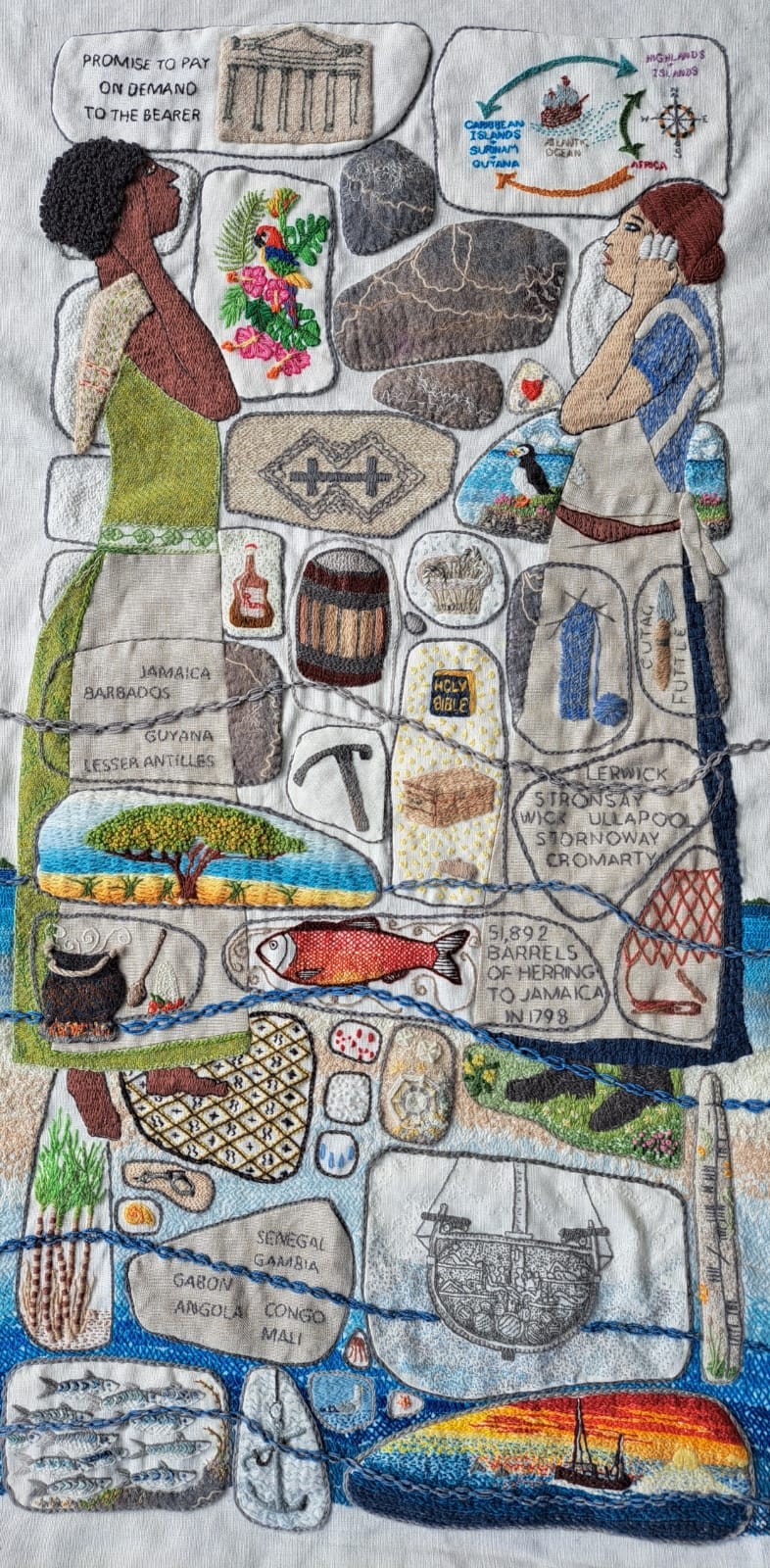
In the late 18th century and early 19th century ships from Britain went to West Africa to transport men, women and children as slaves in appalling conditions, to the West Indies, South America and beyond. The slaves were mainly put to hard and gruelling work on the sugar cane, tobacco, and cotton plantations.
During the same period, the Scottish herring fleets from many ports in the Highlands and Islands , followed the herring shoals as they made their seasonal migrations from the West coast of Scotland round Orkney, Shetland and down the east coast as far as Yarmouth in England. Wick was the main fishing port.
The herring girls signed contracts, were paid in arles and followed the fleets, gutting the fish and cleaning and salting them and loading them into the barrels for storage. The herring lasses took all of their possessions with them.
The industry created jobs for boat builders, net makers, sail makers, coopers, fish merchants and others as well as for the fishermen and herring girls.
Some of the herring was smoked and they called this red herring. A large proportion of the salted and smoked herring catch was shipped to the West Indies to feed the slaves as it was high in protein and could last for months on the long transatlantic voyage. In one year alone, ‘1798’, 51,892 barrels of herring were shipped to the West Indies. Many of the plantation owners were Scottish and some came from the Highlands. They brought the wealth created by the slaves on the plantations back to Scotland and built many fine buildings, some of which survive to this day.
WITH THANKS TO THE HUB STITCHERS
This panel was stitched by Bernadette Finnie, Jacqueline Smith, Alison Phimister, Margaret Clyne and Sheena Norquay who gave their time, skill and energy to completing a fantastic artwork for their area.
If you would like to see the panel up close and admire the detail of their work, you can currently view the panel in the Inverness Castle Experience.